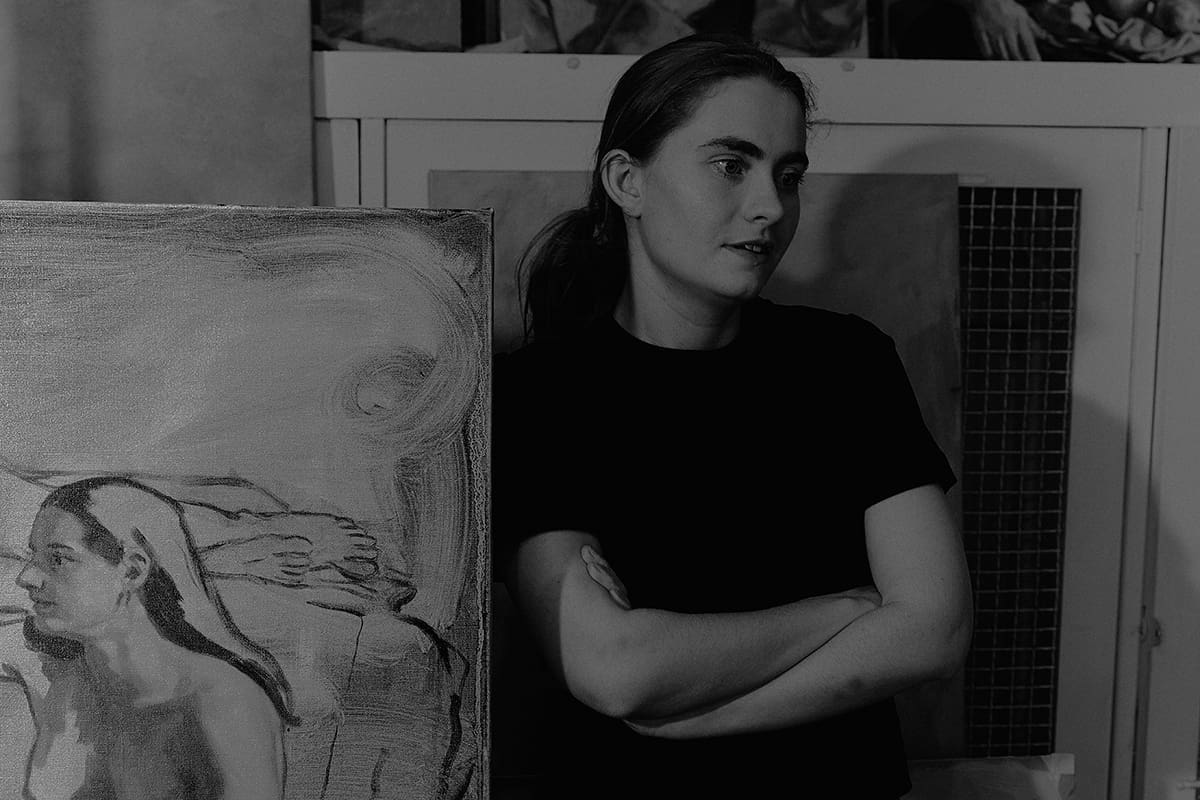
Sis Cowie’s oil paintings of human figures and still life subtly alter our immediate sense of the world. In weighty, layered strokes, Cowie depicts women lying nude amid wrinkled sheets, flora in ambivalent states, pensive figures whose gaze just misses our own.
Working from Naarm/Melbourne, Cowie is a self-taught painter who first studied History (Honours) at the University of Melbourne, developing a penchant for Christian iconography. While not religious herself, Cowie is drawn to the idea of conveying revelation, of pleasure and damnation; fables where life and death hover across the surface. While she previously fused portraiture with cautionary tales, now she gravitates to where the everyday is sacred.
Her paintings recall 15th and 16th century portraiture through posed yet serene figures; carefully tended clothing, textiles and facial features are set amid darkened backdrops. Influences further come from poems and novels, with Cowie using other texts and imagery for inspiration, before employing life models, or her own body, as a foundation for painting.
Despite the historical aesthetic, these paintings are not pastiche. They feel as millennial as writers like Sheila Heti or Otessa Moshfegh — and implicitly feminist. Cowie predominantly depicts scenes religious paintings would have elided: female figures indulging themselves, revelling in their nudity and the comfortable company of other women. Lying languidly or staring enigmatically — these are bodies with quiet power.
Cowie is a recipient of the Brett Whiteley Travelling Scholarship (2023) and a William Fletcher Foundation Grant (2023). She was awarded the Richard Lester Prize for Portraiture (2020) and was a semi-finalist in the Moran Prize for Portraiture (2018).